Exploring the SearchBar Widget in Flutter 3.10
Source: Nagaraj Alagusundaram
With the release of Flutter 3.10, there are many new exciting features. One of them is the new SearchBar widget, which makes it easier to add a fully functional and customizable search bar in your Flutter apps. Here, I’m going to walk you through how to use it.
To start using the SearchBar widget, make sure you have the necessary controllers and focus nodes. In our case, we need _searchController and _searchFocusNode.
Here’s an example of how to use the SearchBar widget:
SearchBar(
  key: const ValueKey("searchBar"),
  controller: _searchController,
  focusNode: _searchFocusNode,
  hintText: "Search",
  elevation: MaterialStateProperty.all<double>(10.0),
  constraints: const BoxConstraints(
    minHeight: 50,
    maxHeight: 50,
    minWidth: 100,
    maxWidth: 300,
  ),
  padding: MaterialStateProperty.all<EdgeInsets>(
    const EdgeInsets.only(left: 10.0),
  ),
  leading: _searchFocusNode.hasFocus
      ? const Padding(
          padding: EdgeInsets.only(left: 8.0),
          child: Icon(Icons.search, color: Colors.black26),
        )
      : null,
  backgroundColor: MaterialStateProperty.all<Color>(Colors.white),
  shadowColor: MaterialStateProperty.all<Color>(Colors.grey),
  shape: MaterialStateProperty.all<RoundedRectangleBorder>(
    RoundedRectangleBorder(
      borderRadius: BorderRadius.circular(10.0),
    ),
  ),
  textStyle: MaterialStateProperty.all<TextStyle>(
    const TextStyle(
      color: Colors.black,
      fontSize: 16.0,
    ),
  ),
  hintStyle: MaterialStateProperty.all<TextStyle>(
    const TextStyle(
      color: Colors.black26,
      fontSize: 16.0,
    ),
  ),
  onChanged: (value) {
    print(value);
  },
  overlayColor: MaterialStateProperty.all<Color>(
    Colors.red.withOpacity(0.1),
  ),
  onTap: () => print("onTap"),
  trailing: [
    if (_searchFocusNode.hasFocus &&
        _searchController.text.isNotEmpty)
      IconButton(
        onPressed: () {
          _searchController.clear();
          _searchFocusNode.unfocus();
        },
        icon: const Icon(
          Icons.clear,
          color: Colors.grey,
          size: 20,
        ),
      ),
  ],
  side: MaterialStateProperty.all<BorderSide>(
    const BorderSide(
      color: Colors.black26,
      width: 1.0,
    ),
  ),
  surfaceTintColor: MaterialStateProperty.all<Color>(
    Colors.red.withOpacity(0.1),
  ),
)
Please make sure to replace _searchController and _searchFocusNode with your actual TextEditingController and FocusNode instances when you use this code. Also, don’t forget to handle the controller and focus node’s lifecycle (initialization and disposal).
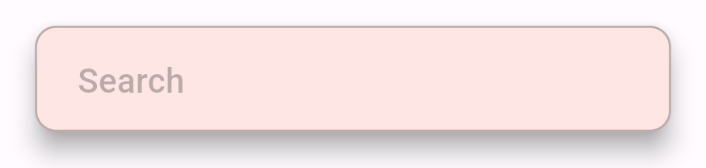
The SearchBar widget in the example above has a lot of customizations:
keyis used for identifying the widget in Flutter’s widget tree.controlleris used for reading the text input.focusNodeis used to control the focus of the widget.hintTextis used to show placeholder text when there is no input.elevation,backgroundColor,shadowColor,shape,side, andsurfaceTintColorare used for styling theSearchBar.textStyleandhintStyleare used for styling the input text and placeholder text, respectively.onChangedandonTapare callback functions that are triggered when the input changes and theSearchBaris tapped, respectively.trailingis a list of widgets that are placed after the text input.
By leveraging these properties, you can customize the SearchBar widget according to your needs.
This new SearchBar widget definitely makes it easier to add and style search bars in your Flutter applications. Enjoy exploring it!